The world has grown smaller
Around the World in Eighty Days“The world has grown smaller” is the novel’s compact expression for how modern transport compresses travel time without erasing distance or uncertainty. Spoken in the Reform Club’s debate over whether a bank thief could escape, it becomes both a practical claim about pursuit and the premise on which Phileas Fogg’s eighty-day wager depends.
The phrase and its argument
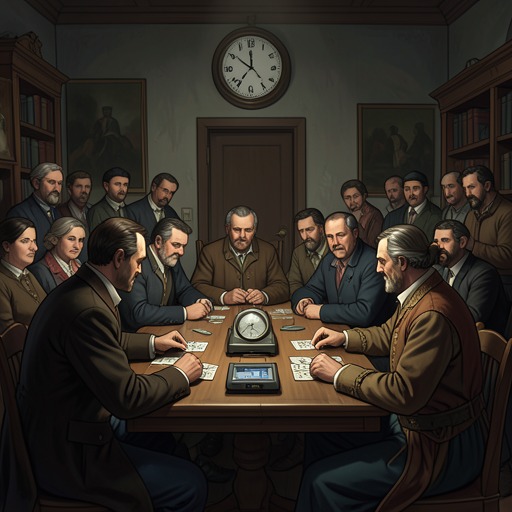
The expression enters a conversation about the search for the thief. Phileas Fogg says that the world was once larger; Ralph agrees, arguing that a person can now go around it ten times more quickly than a hundred years earlier. That speed, Ralph reasons, makes the search more likely to succeed. The argument immediately turns against itself: faster travel can also make it easier for the thief to get away. The smaller world is therefore not simply safer or more controllable. It accelerates the movements of those pursuing someone and of the person trying to evade them.
The discussion gives the idea a measurable form. When Stuart refers to going around the world in three months, Phileas Fogg corrects him: eighty days. John Sullivan links that estimate to the opening of the railway section between Rothal and Allahabad on the Great Indian Peninsula Railway. The phrase thus moves from a general observation about historical change to a specific calculation, dependent on a newly completed stretch of track and a connected network of routes.
Transport, distance, and uneven connection
The account of India sets the new speed against older forms of travel. Journeys that once depended on walking, riding, palanquins, or cumbersome coaches can now be made by fast steamers on the Indus and the Ganges and by a railway crossing the peninsula from Bombay to Calcutta in three days. Yet the railway does not follow a direct line: although the cities are only about one thousand to eleven hundred miles apart as the bird flies, the route’s deflections add more than a third to the distance. Faster movement compresses time, but the geography beneath the timetable remains irregular.
That transformation takes place across a country described as politically and socially changing. The account distinguishes the larger territory of India from British India proper, notes that some interior states remain independent, and describes the East India Company’s former authority giving way to direct Crown control. The new transport system is part of this changing landscape, not an abstract network detached from it. The novel’s claim about a smaller world rests on routes and institutions that cross a vast and unevenly governed territory.
The test of the journey
Phileas Fogg’s conduct makes the schedule visible in small, exact actions. At Bombay he leaves the Mongolia, sends Jean Passepartout on errands, insists that he be at the station by eight, and walks to the passport office with a step compared to an astronomical clock. The city’s buildings, markets, places of worship, and other sights do not detain him. The railway’s promise of speed is matched by a traveler who treats each minute as part of the route.
That confidence does not mean the journey is immune to physical conditions. In the Red Sea, rough weather makes the Mongolia roll and sends passengers below deck; music and dancing stop. The ship nevertheless continues toward the straits of Bab-el-Mandeb without being slowed by wind or waves. Phileas Fogg gives no outward sign of anxiety and carries on with his meals and whist. The scene contrasts the sea’s caprice with the apparent steadiness of the timetable, while leaving the underlying risk in view: a world made traversable more quickly is not a world in which weather has ceased to matter.
The measure and its limits
On the General Grant, the itinerary offers a further test of what “smaller” means. On 23 November, Phileas Fogg has crossed the 180th meridian and reached the opposite side of the globe from London. Fifty-two of the eighty days have elapsed, leaving twenty-eight. He is only halfway around the globe by meridians, yet has already covered two-thirds of the journey he must make: seventeen thousand five hundred of an estimated twenty-six thousand miles. Long detours have made the traveled distance much greater than a simple measurement around the earth would suggest.
The contrast between the meridian and the mileage sharpens the expression’s meaning. The world is smaller in the sense that steamships and railways permit extraordinary speed, but the actual journey still depends on indirect connections, schedules, and conditions along the way. The wager turns this tension into a race: a global distance can be calculated and crossed within a deadline, but only by continually converting transport links into time gained or lost.